EV Charger Installation
Level 2 home charging installed properly — load calculation first, permit pulled, and honest advice about whether your panel can take it.
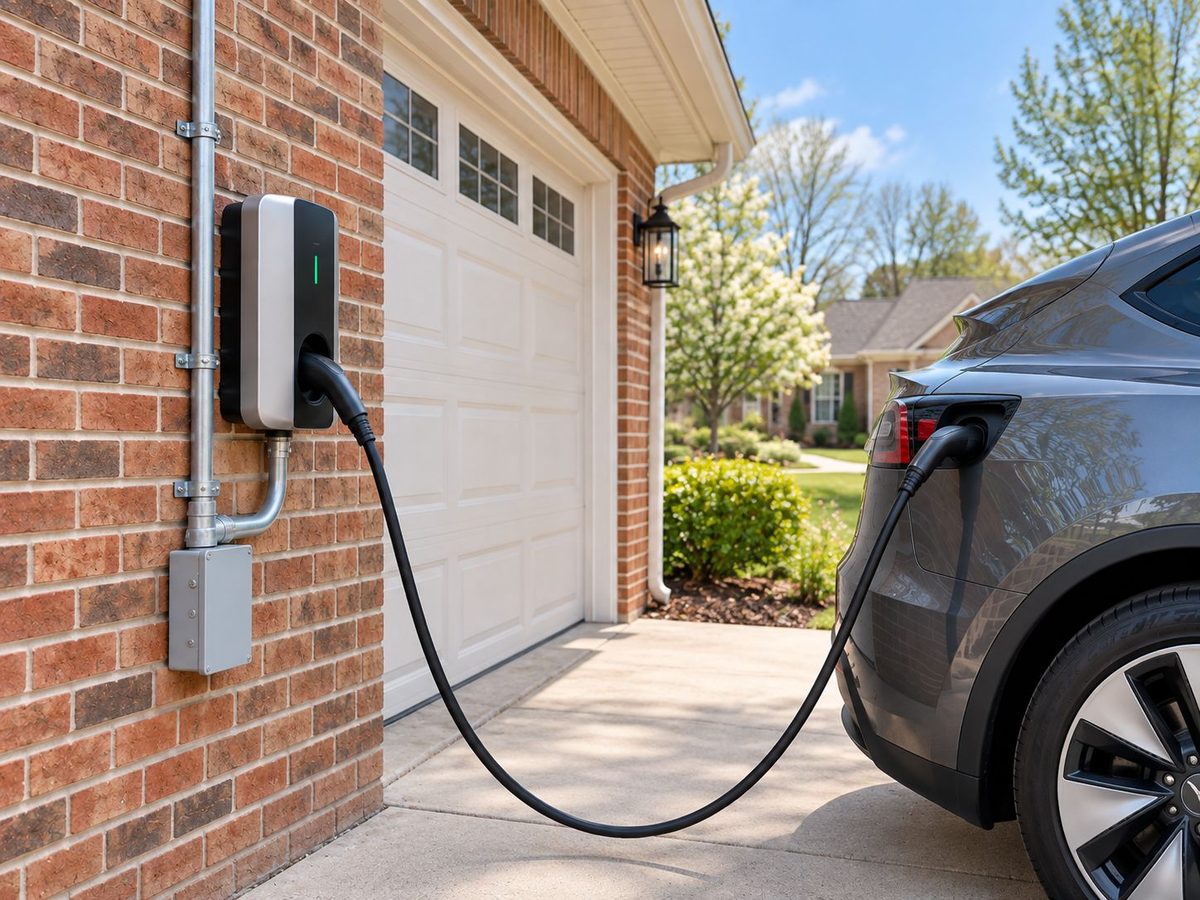
A Level 2 charger turns an overnight top-up into a full battery. On the 120-volt outlet in the garage you are adding three or four miles of range an hour; on a properly installed 240-volt circuit you are adding twenty-five to forty. For almost anyone charging at home, that is the difference between planning around the car and forgetting about it.
Castro Electric installs Level 2 chargers across Richmond, Chesterfield and the surrounding counties. We run the load calculation first, tell you honestly what your panel can carry, pull the permit, and test the finished install with your car before we leave.
The question that decides the price
Not which charger you buy — whether your existing service can carry it. A 48-amp charger needs a 60-amp circuit and real headroom in the panel. A 32-amp unit needs considerably less. On a 200-amp service with a modern panel and spare spaces, the job is straightforward. On a 100-amp service already running central air and an electric range, it may not be, and no amount of optimism changes that.
This is why quotes for the same job can differ by more than a thousand dollars: one has assumed the panel is fine and the other has priced the service upgrade. A quote given without a load calculation has not really priced the job. We do the calculation first and put the result in writing, so you know which of the two situations you are in before you commit to anything.
Where the service genuinely is too small, the charger and the panel upgrade are best done together — one outage, one permit, one visit. Our electrical panel upgrades page covers what that involves.
Hardwired or plug-in?
Both are code-compliant when done correctly, and the right answer depends on the unit and where it is going.
- Hardwired is required for some chargers and preferred for most outdoor installs. It is the tidier, more weather-resistant result, and it is the only option above 40 amps of continuous draw.
- A NEMA 14-50 outlet lets you unplug the unit and take it with you if you move. Under the 2020 code, a receptacle feeding an EV charger has to be GFCI protected — which is why a competent 14-50 install costs more than the bare outlet a handyman would fit.
We install whatever unit you have chosen — Tesla Wall Connector, ChargePoint Home Flex, Wallbox, Grizzl-E, Emporia and the rest. If you have not chosen yet, tell us the car and how far you drive and we will tell you what actually matters for your situation, which is usually less than the marketing suggests.
What the install involves
- Load calculation and a look at the panel. Roughly thirty minutes, and it determines everything that follows.
- Route planning. Where the charger goes, where the cable needs to reach, and the cleanest run from the panel to it.
- Permit. We pull it.
- The circuit. New breaker, conductors sized for a continuous load, conduit where it is exposed, and GFCI protection where the code calls for it.
- Mount and connect. The unit goes on the wall or pedestal, hardwired or on the outlet.
- Inspection. The county or city signs it off.
- Test with your car. We charge the vehicle before we leave and walk you through the app setup and any scheduling features.
Most installs are a half day. A detached garage, a long run under a driveway, or a panel that needs work first will take longer, and we will say so when we quote rather than discovering it on the day.
What it costs
Quotes for EV charger installation vary more than almost any other job we do, and it is rarely the charger that explains the difference. These are what actually drive it:
- Distance from the panel to where the car parks — the single biggest labour variable
- Whether the run is inside a finished wall, through a crawlspace, or outside to a detached garage
- Trenching, if the conduit has to go under a driveway
- A 48-amp unit versus a 32-amp one, which changes the wire size
- A sub-panel, if the panel has no spare spaces but the service itself has capacity
- A full service upgrade, if the load calculation shows the service is too small
The last two are why one quote can be twice another. Ours is free, it follows the load calculation, and it says plainly which of those situations you are in.
Incentives, honestly
The federal 30C tax credit is gone. It covered 30% of an installation up to $1,000, but only for property placed in service on or before 30 June 2026. A good many pages still advertise it. If you are reading one that does, it has not been updated.
What is still worth looking at in this area:
- Dominion Energy’s Off-Peak Plan. Shifting charging to off-peak hours is the single largest ongoing saving available to most EV owners here, and it costs nothing to switch. Most chargers can be scheduled to start automatically, and we will set that up with you.
- Dominion’s Residential Charger Installation Program, where Dominion supplies, installs and maintains a charger for a monthly fee of roughly $40. Worth comparing against buying outright — it suits some households and not others, and we are happy to talk it through even though it is not work we would be doing.
- Your car manufacturer. Several still bundle a charger or an installation credit with a new vehicle. Check before you buy hardware.
Permits and code
EV charger circuits are permitted and inspected work. We handle it — Chesterfield County through the Enterprise Land Management portal, with inspections booked on 804-751-4444 up to five business days ahead; the City of Richmond through the Department of Planning and Development Review; Henrico, Hanover and the rest through their own offices.
Everything is installed to Article 625 of the 2020 National Electrical Code, which Virginia adopted statewide on 18 January 2024. Skipping the permit is a false economy: it surfaces at resale, and an uninspected 60-amp circuit is not something you want to discover a problem with later.
Where we work
Richmond, Chesterfield, North Chesterfield, Midlothian, Chester, Henrico, Glen Allen, Short Pump and Mechanicsville. Licensed and insured in Virginia — Class A contractor licence 2705184098.
What’s included
- Load calculation before anything is quoted
- Level 2 chargers, hardwired or on a 240-volt outlet
- Tesla, ChargePoint, Wallbox, Grizzl-E, Emporia and others
- Permit pulled and inspection scheduled by us
- Runs to detached garages, carports and driveways
- Panel or sub-panel upgrade where the service needs it
- GFCI protection to the 2020 code
- Tested with your car before we leave
Frequently asked questions
How long does it take to install an EV charger?
Most installations are a half day. A long run to a detached garage, trenching under a driveway, or a panel that needs upgrading first will take longer — we will tell you which of those applies when we quote, not on the day.
Do I need to upgrade my electrical panel for an EV charger?
Sometimes, and only a load calculation will tell you. A 200-amp service with spare capacity usually takes a charger without difficulty. A 100-amp service already running central air and an electric range often cannot. We run the calculation before quoting, so you are not told halfway through the job.
Can I still claim the federal EV charger tax credit?
No. The federal 30C credit applied to equipment placed in service on or before 30 June 2026 and is no longer available. Dominion Energy’s off-peak rate plan is now the main ongoing saving for EV owners in this area, and some carmakers still include a charger or installation credit with a new vehicle.
Should I get a hardwired charger or a 240-volt outlet?
Hardwired is required above 40 amps of continuous draw and is the better result outdoors. A NEMA 14-50 outlet lets you take the unit with you if you move. Under the 2020 code a receptacle feeding an EV charger must be GFCI protected, so a correct outlet installation is not simply a matter of fitting a socket.
How fast will my car charge on a Level 2 charger?
Typically twenty-five to forty miles of range per hour, against three or four on a standard 120-volt outlet. The exact figure depends on the car — its onboard charger sets the ceiling, so a 48-amp unit will not charge a car faster than the car can accept.
Can you install a charger at a detached garage or on the driveway?
Yes. It needs a run from the panel, sometimes in trenched conduit under a driveway, and a pedestal mount where there is no wall. It costs more than a charger on the wall beside the panel, and we will price it properly rather than quoting a garage-wall figure and adjusting later.